
PX300 Soil Stabilizer
PX300 Soil Stabilizer
At Integrated 8(a), we provide more than PX300 Soil Stabilizer—we provide the field expertise to ensure it is applied effectively for your specific project. Our team helps determine the proper dilution, application method, and equipment for each site. Whether stabilizing roads, road bases, paths, trails, access roads, equipment pads, or athletic fields, or controlling dust and erosion, we work with you to develop the right PX300 solution.
PX300 is an environmentally friendly, non-toxic, non-polluting liquid co-polymer resin that can:
Reduce construction and maintenance costs for roads—by producing a highly impermeable surface (2.9 x 10⁻⁹ cm/sec permeability)
Road base
Unpaved / Secondary Roads
Utility Maintenance Roads
Haul Roads and Mining Roads
Construction Access and Agricultural Access Roads
Be used to establish pads and lots, including:
Parking Lots
Machinery and Equipment Lots (Laydown Areas)
Construction Pads, Helicopter Pads, and Compost/Mulch Pads
Housing Developments
Create natural-looking trails and paths—using either the existing onsite soil to preserve the natural look or decomposed granite
Walking, Hiking, and Equestrian Trails
Bicycle Paths
Walkways
Be effectively used to stabilize the underlying base to increase the longevity of artificial turf fields
Football, Soccer, and Baseball Fields
Arenas and Multi-purpose Fields
Play Areas
Be used as a safe carrier for hydroseeding
Bind soil particles to resist ambient dust (dust control) as well as wind and water erosion (erosion control)—no compaction is required
Construction Site Dust
Freeway Embankments
Unpaved Freeway Medians
Slope Erosion Control
Agricultural Dust
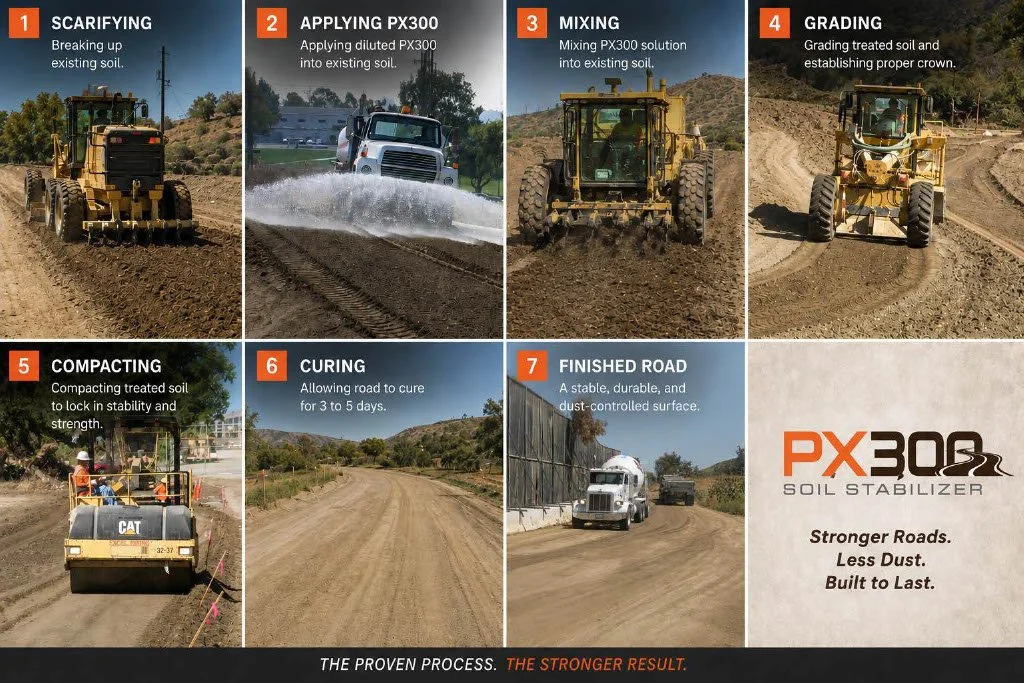
PX300 Road Application Process
Road, Pad, and Parking Lot Experience
Catalina Island Conservancy Airport Road, Catalina Island, CA
Asphalt Road Sub-base, Midway City, CA
Trabuco Canyon Fire Road, Trabuco Canyon, CA
County of Riverside Heirloom Avenue Road, Perris, CA
Stabilized Mountain Road, San Diego, County, CA
Outlet Mall Parking Lot, San Clemente, CA
Shell Oil Co. Temporary Parking Lot, Long Beach, CA
Chip Seal over Stabilized Road Bed, Summit Valley Road, Hesperia, CA
West Los Angeles College Haul Road, Los Angeles, CA
County of San Bernardino, Occotillo Road, Apple Valley, CA
Parking Lot Base with Asphalt Wear Surface, HI
Waste Management Landfill Base
Crushed Coral Rock over Stabilized Road, Okinawa, Japan
Japan Self-Defense Force Fuji School, Japan
International Stabilized Roads, Pads, and/or Lots:
Mozambique
Angola
South Africa
Kosovo
Mexico
Canada
South Korea
China
Egypt
Costa Rica
Panama
Japan
Sweden
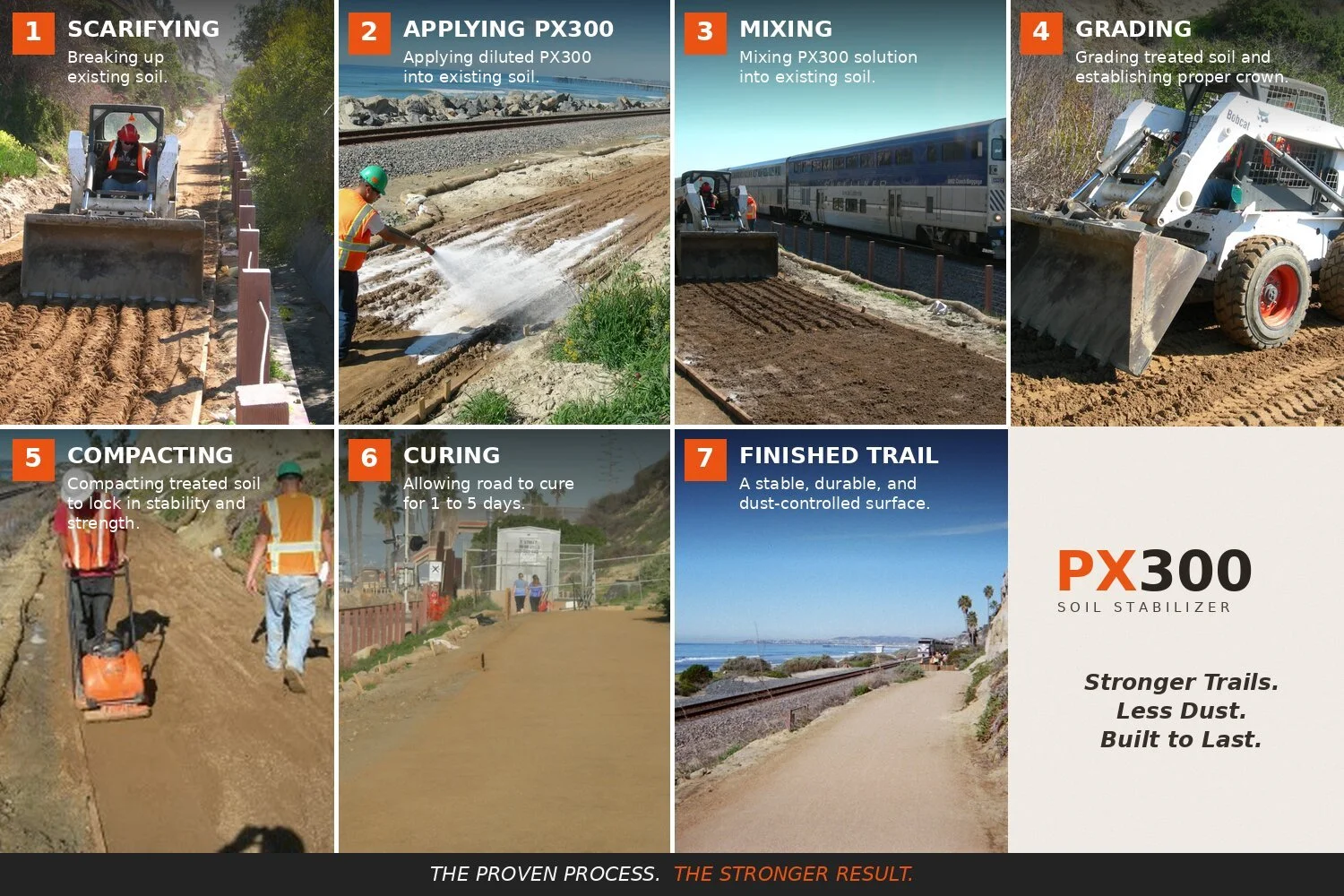
PX300 Trail Application Process
Trail Experience
Doheny California State Park Campground Trail, Dana Point, CA
Lake Gregory Trails, San Bernardino National Forest (EL 4,500 ft), CA
Upper Table Rock Trail Head Pathway, Medford, OR
Bonner Canyon Trail, Irvine, CA
El Moro State Campground, Newport Beach, CA
Los Angeles Unified School District Walking Trails, Los Angeles, CA
San Clemente Rails Pedestrian Trail—Phases 1 & 2, CA
Mitchell Caverns Handicap Accessible Trail, Mojave Desert (EL 4200 ft), CA
Garnet Ghost Town Forest Trail (EL 7000 ft), Missoula, MT
Mt. Laguna Cleveland National Forest, San Diego County (EL 5900 ft), CA
Bell Canyon Horse Trail, Trabuco Canyon, CA
Meadowdale Beach Park and Estuary, Edmonds, WA
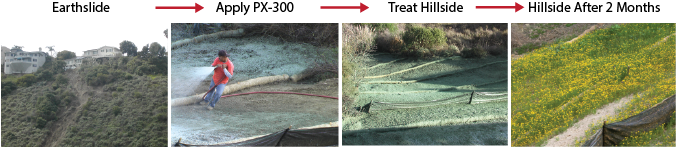
PX300 Erosion Control & Hydro-Seeding Application Processes
Dust and Erosion Control Experience
Freeway Medians for Dust Control (throughout California)—CalTrans
Slope Erosion Control and Dust Control—County of San Bernardino, CA
Slope Erosion Control and Dust Control—County of Riverside Road Department
Hillside Slope Erosion Control—Sempra Energy
Erosion Control Falling Waters Residential Development, Palm Desert, CA
Erosion Control, Ontario Dairy Lands, Ontario, CA

PX300 Stabilization Process for Athletic Fields
Athletic Fields
Concordia University—Football Fields, CA
West Los Angeles College—Football and Baseball Fields, CA
Campbell Hall College—Soccer & Football Field, CA
Los Angeles Harbor College—Football Field, CA
Pacific Palisades High School—Football Field, CA
Beverly Hills Union High School—Football Field, CA
City of Bonita—5 Baseball Fields, CA
Banning High School—Football Field, Los Angeles, CA
City of Moreno Valley—5 Soccer Fields, CA
Frequently Asked Questions About PX300
What is the composition of PX300?
PX300 is a special blend of enzymatic co-polymer emulsions developed by our colleague Greg Boston (founder of G.M. Boston Company). Development began in 1969 with several improvements made to the formula to increase its ability to bind soil particles—making the soil very dense and resistant to water penetration. PX300 is diluted with water depending on the soil stabilization project.
What types of soil will PX300 stabilize?
PX300 can be used with a wide variety of soil types—from sandy to hard clay—by varying the dilution rate of PX300 to water in the application process. A more concentrated product/water mixture is used to stabilize sandy soil; while a less concentrated product/water mixture is used to stabilize dense clay soil. Here are some examples of soil types that PX300 can effectively stabilize:
Does rain, snow, or hail cause deterioration to roads, trails, or pads constructed with PX300 stabilizer?
Roads constructed with PX300 are highly impermeable and highly compacted. We have achieved permeability levels of 2 x 10⁻⁹ cm/sec under ASTM 5084 and compaction results as high as 95%. Because potholes result from water penetration, the water-resistant quality and density of PX300-bound surfaces eliminate the need for constant road maintenance after seasons of rain and storms.
Can PX300-stabilized soil withstand freeze/thaw cycles?
Yes! PX300 applications are not affected by freezes closely followed by thaws. The impermeability of PX300 treated roads means that no cracks due to standing water during thaw periods will undermine the integrity of the surface.
For example, a PX300 road base finished with a chip-seal surface in the County of San Bernardino, CA, has withstood 7 years of freeze/thaw weather without any maintenance needed.
Does heavy traffic affect PX300 stabilized roads?
Roadbeds and unpaved roads constructed with PX300 are highly durable. In laboratory testing, PX300/water/soil combinations have produced unconfined compressive-strength levels of 1233 PSI (ASTMD 2166). Such strength will readily endure heavy traffic.
How does PX300 save construction and maintenance costs?
Typically, there is no need to import base material when using PX300 in road, pad, or field construction. Instead, PX300 is mixed with the native, onsite soil to produce a solid lasting base. Adding PX300 to native material reduces costs in two ways due to its extremely low permeability.
The low permeability of the PX300 base reduces the occurrence of potholes, thereby saving on maintenance costs. (Click icon to downloadPX300 Permeability Lab Test Results)
If an additional asphalt wear surface on a road is desired, the asphalt surface can be much thinner than traditionally required. Reducing the amount of asphalt equates to big savings. In some situations, a chip-seal surface is all that is required—resulting in additional savings.
In other situations (rural roads, utility maintenance roads, etc.), no additional asphalt surface is desired or needed. For example, PX300 was used to construct a 0.5-mile (800m) road for the County of Riverside, CA, over 8 years ago, without any additional surfacing. The road carries 500+ cars/day and has not required any additional maintenance.
Will PX300 harm the environment?
No. PX300 is an environmentally safe, non-toxic chemical. It will not harm plant, aquatic, or animal life. Leachability tests found that no harmful substances leached into surrounding soil from applications of PX300. (Click icon to downloadPX300 Leachability (TCLP) Laboratory Tests). Under EU REACH regulations, PX300 copolymer is currently exempt from the standard registration and evaluation requirements.
Will PX300 harm plants, animals or aquatic life?
No. PX300 is entirely non-polluting and safe. It is non-toxic, non-carcinogenic, non-flammable, non-combustible. It can be safely and effectively used for hydroseeding. (Click icon to download Safety Data Sheet)
How does PX300 control dust and erosion?
When a very dilute solution of PX300 is sprayed over dusty soils, the product binds the soil to a depth sufficient to trap surface particles that would otherwise be blown by the wind or washed away by rain.
If left undisturbed, the crusty cover can last through several seasons. However, the surface can easily be broken up for use in agriculture or construction operations. PX300 dust applications help contractors and government agencies avoid penalties for air quality violations that can occur during construction projects.
PX300 is not only compatible with hydroseeding, but PX300-treated soil enhances plant growth by allowing germination to take place uninhibited by wind and/or water erosion.
Will PX300 change the appearance of the natural soil material?
PX300 is white in color, but it turns transparent as it dries—making it effective for nature trails and rural roads and creating a natural appearance that is superior to geomembranes and geosynthetic fabrics.
What is the cost of a PX300 application?
For pricing information based on your requirements, please contact us by phone or e-mail.
Sandy soil
Gravel
Silty soil
Volcanic ash
Clay
Crushed asphalt
Crushed concrete
Combination/Mixed soils
Let’s Work Together